|
|
||||||||
|
|
||||||||

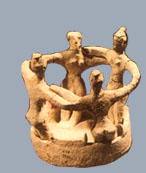 |
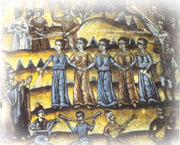
There is an abundance of references to dancing at different times of the Greek history. These references are found mostly in texts or various representations on pottery, sculptures, church murals, etc. However, this information is disjoint. And although, researchers believe that there is enough knowledge on dancing at different times, the question of the continuity in dancing - as in all aspects of our everyday life - is an open subject. Many researchers believe that the traditional dances of today are the same ones that Homer describes in his epic poems and are painted on church murals of the Byzantine times among saints and angels. "..The dominant formation in all ancient Greek dances seemed to have been the circle, open, closed or spiralling..." |
|
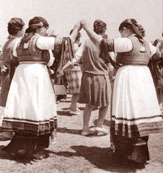
| There are many similarities among Greek dances of different times: the way hands are held, the way the body is kept straight, the dancing formations followed by the dancers, the handkerchiefs and other objects the dancers carry while dancing. Dancing is a live expression of the human life, and as a live expression, has a higher probability of being easily carried over from generation to generation. However, other researchers argue that these same elements that many consider Greek can be observed in the dancing traditions of other people, especially those who live close by, in the Balkans and in the Mediterranean countries. |
 |
|
The first example refers to the story of Theseus who killed the Minotaur at the labyrinth of Knossos. On his way back to Athens, Theseus stopped at Delos where he offered sacrifice to the gods for having saved him. During the sacrifice, he danced a dance with serpentine movements which represented his tortuous path through the maze and the tight ring in which the fight with the Minotaur took place. This is the dance of the labyrinth or Geranos ( Geranos ) as it is known in the ancient texts. Historians put this myth at the time of the power of the Minoan civilization, that is more than 3000 years ago.
Some researchers consider the dance Tsakonikos, which is done nowdays in Peloponnesus, the continuation of the ancient Geranos. Other researchers claim that winding patterns are very common in the dances of many people. However, in most other regions these dances and formations are associated with the snake. In the Greek world, however, these dances are associated with Theseus and the labyrinth.
In fact, Dora Stratou, a pioneer in the study of Greek folk dances, discovered a similar dance in Crete which was called "dance of Theseus" at the beginning of this century. Today, it is called Siganos (Siganos, Slow) and it is a wedding dance, led by the groom, who thereby learns how to get out of the labyrinth of life. Dora Stratou mentions another dance with winding formations in Paros, which is still called Ageranos today, a name similar to Geranos of the ancient Greeks.
 |
Strong evidence on the continuity of our musical and dancing tradition can also be found in the rhythm of our traditional songs and dances. The rhythm of Kalamatianos (7/8) can be traced back to the choral parts of the tragedies of Aeschylus. This rhythm can not be found in the traditional music of other people, except for some Balkan dances, where it is still recognized as being borrowed from the Greek world. Here we are not going to take any strong position on the subject of the continuity of Greek dancing in the course of the Greek history. We are not experts on the subject of dance. Our knowledge comes mostly from reading and, of course, love for dancing, but not from deep and systematic research. Therefore, we are going to present this information as we have studied it, and we will let you, the visitors draw your own conclusions. |
 To Main Page & Table of Contents
HISTORY AND EVOLUTION