|

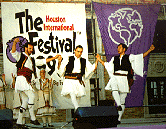
"The most important characteristic of the Greek dance is its intimate relationship to the phrasings of the words which accompany it..."
GENERAL CHARACTERISTICS OF GREEK DANCES
The traditional Greek dances fall into two distinct categories: The restrained "shuffling" or "dragging" dances (Συρτός) and the lively "leaping" dances (Πηδηκτός).
The shuffling dances get their name from the fact that the dancers move to the right or to the left with light steps, without leaping. The shuffling dances provide the greatest variety regarding steps, figures, names, melodies and rhythms. They also seem to be the most ancient. The most important of the shuffling dances include: Haniotikos (from Hania in Crete), Kalamatianos (initially from Peloponnesus and Roumeli, now a Panhellenic dance), Syrtos in three or in two (Epirus and Macedonia), etc.
The leaping dances are named after the leaps that characterize the movements of the dancers, especially the leader who displays his dancing technique with a series of dazzling leaps, turns, and fancy maneuvers. These dances, originated on the ragged mountains of Greece, require strength, lithe movement and are ap-propriately danced mainly by men, though women take part in them as well. The most important ones include: Pentozali, Malevyziotikos and Sousta in Crete,Tsamikos (or Klephtikos) in mainland Greece, Epirus, and Thessaly, etc.
For the most part the steps of the Greek dances are simple: stepping to the side, followed by a closing of the feet together or a passing of the foot in front or behind the other, hopping, pointing of toes, and occasionally a swing of the legs through the various positions in the air accompanied by a hop or bend and stretch of the supporting leg. The leader embroiders these simple steps and works up excitement by increasing either the speed of the dance or the number of jumps and turns.
|
|
Until recently men and women seldom danced together, although chains of men and women danced at the same time, the women's chain often being led and terminated by a man. The few women's dances are very simple and most dignified. The men's dances are often punctuated by feats of strength. The few couple dances were probably introduced by the Venetian and other Crusading Knights during the Holy Wars, and particularly at the time of the Fourth Crusade. Most of the dances are performed in open circles thereby precluding individual arm movements except for the leader who waves the inevitable kerchief.
|
The most important characteristic of the Greek dance is its intimate relationship to the phrasings of the words which accompany it. This intimate relationship was one of the great features governing the expressive activities of the dancing chorus of the famous Greek tragedies. Many Greek dances have time signatures of 7/8 or 5/4; others of 3/8 and 2/4. But the dancer never takes 7, 5, 3, or 2 steps to the bar. Instead the series of steps (or enchainement) is phrased with varying patterns of quick and slow steps which match the exact rhythm of the words. For example, if the syllable or the word occupies 3, 1 1/2, or even a 1/2 beat, the step will take that amount of time to perform. This phenomenon is explained by the fact that the Greek language relies on the varying length of the syllables in order to get the correct inflation and rhythm of the sentences. If the syllable or word is stressed, then the step is correspondingly emphasized.
The second unusual feature is the rapidly changing position of the dancers in relation to the line of dance. The dance usually starts with the right foot and moves counter-clockwise. In the slower dances this change usually occurs with every step, as in the Kalamatianos, in which the dancer begins facing the center, turns his back to the line of dance and then faces it, when performing his first three steps. In quicker dances these changes are not so frequent. To achieve these quick changes of directions, the dancers’ bodies are held extremely upright and the weight of the body is moved directly forwards with the foot movement. This gives a very smooth and frieze-like quality to the line of dancers. The slow step is usually large, allowing the dancers to progress, whilst the quick ones are mostly done in place. The foot is held almost flat to the ground; and in hopping steps, the women tend to slide the feet along the ground, whilst the men’s feet move upwards.
Dora Stratou observes another characteristic points of the Greek dances: "...However intense a dance may be, even if it is steadily accelerating its rhythm, it never goes beyond the proper limits. For example, you may hear a Cretan lyre playing the Pentozalis, going "full-speed-ahead", whipping it up faster and faster. And you expect it all to end at a frantic pace. But not at all! It just stops short, abruptly, with a down-stroke of the bow, as though nothing at all had happened. The same holds true of the dancers. You may see a dancer growing more and more excited and the dancer simply stops and sits down calmly. The "golden mean" of the ancients prevails...".
REGIONAL CHARACTERISTICS
Although all greek dances share many common characteristics, regional characteristics in the steps and styling have been developed over time.
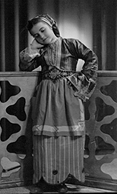
One factor in developing regional characteristics has been the different neighbours or occupations of each region through the years. Areas closer to Slavic people have exchanged elements of their traditional life with them. Some of the Aegean dances show influences from the Western world. In Cyclades, one encounters the notion of the dancing couple: men dancing with other men, women dancing with other women or men dancingwith women. Couple dances, such as Ballos and Karsilamas, are leftovers of the Western occupations and the crusades. The same is true for some Ionian islands which were occupied by the Venetians until the 18th century. Corfu seems to have more western influences than any other island in both the music and the dancing style. The dances are graceful, coquettish, and full of erotic swaying.
The land morphology and the climatic conditions have also played an important role in developing local characteristics on dance. In general, shuffling dances (surtoi) are danced in the plain areas, while the leaping dances are a characteristic of mountainous areas. The weather and the land morphology may affect the dancing style and steps in various ways: the people's attitudes and personalities, their social life, the number of occupations they had through their history, the regional costumes, etc. For instance, cold weather, high mountains, and ragged land dictate the use of heavy dresses and heavy shoes, which make people move with small steps and drag their feet while dancing. Footwear, especially, can be very important in influencing the dancing style: Heavy leather clogs (tsarouxia) are cumbersome and make it difficult to lift one's feet off the ground, while pigskin shoes (gourounotsarouxa) are considerably lighter, high boots (stivania) permit precision of movements and slippers (kountoures) impose shuffling steps.
The dances from mainland Greece are heavier and slower. Many songs and dances are coming to us from the Independence War of 1821. These dances praise the victories of the Greeks and their decisiveness for freedom. On the other hand, the Aegean island dances are characterized by the "lightness" of steps and the soustarisma in the knees, the steps and the leaps of the lead dancers, which stay close to the ground and the general variety of expressions.
The typical musical orchestra, encountered in mainland Greece, is the Zygia. Zygia is made up by the clarinette, the violin, the lute and the santouri. In certain cases it may include the daouli (drum) or the tambourine, which is very common in Epirus. In the islands, the musical accompaniment used to be the lute and lyre. Nowdays the lyre has been replaced by the violin, except for Crete where the lyre and lute are played exclusively lute and lyre. Nowdays the lyre has been replaced by the violin, except for Crete where the lyre and lute are played exclusively.
 Table of Contents
GREEK DANCING TODAY
|